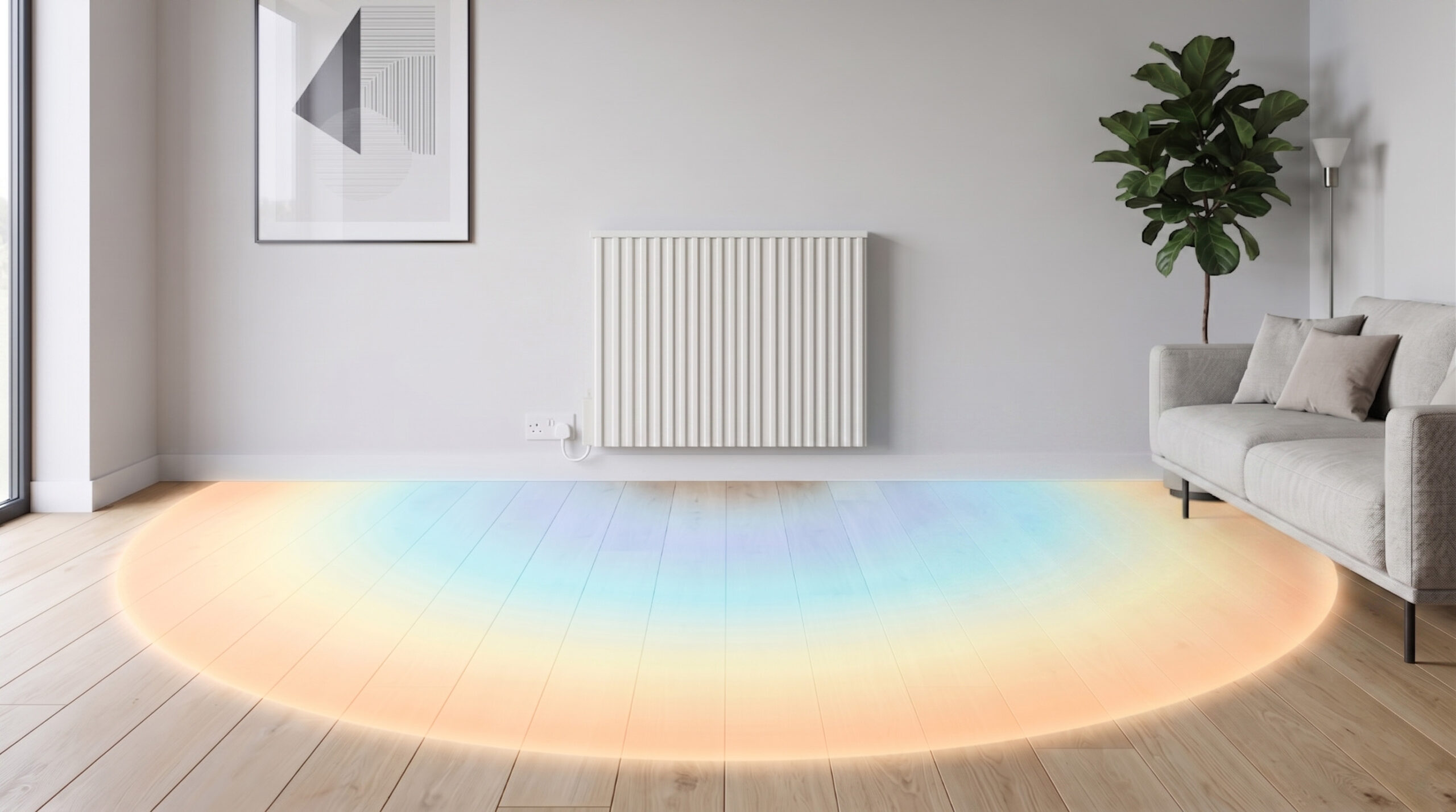
If all electric heaters are 100% efficient, why do some cost more to run than others? It’s a fair question. The simple truth is that while every electric resistance heater converts every unit of electricity into a unit of heat, the real-world difference lies in how that heat is delivered and controlled. This is where the hidden physics of thermal mass determines your actual bills, not the conversion rate on a spec sheet.
Are All Electric Radiators Equally Efficient?
No. While all electric heaters are 100% efficient at the point of use (1kW of electricity in equals 1kW of heat out), their operational efficiency varies dramatically. This is the real measure of performance: how well a heater delivers consistent warmth without constantly drawing power. True efficiency is about minimising the time a heater is switched on, not just the energy it converts.
What is Thermal Mass in Heating?

Thermal mass is a material’s natural ability to absorb, store, and slowly release heat. Think of a stone wall that stays warm long after the sun has set. In heating, a high thermal mass acts like a ‘heat battery’. It stores energy when active and continues to radiate warmth for a significant period after the power is cut, preventing rapid temperature drops and reducing the need for constant recharging.
Does Thermal Mass Really Save Energy?
Yes, by reducing the ‘duty cycle’ – the percentage of time a heater is drawing power. A low-mass panel heater might run for 20 minutes every hour (a 66% duty cycle) to maintain a set temperature. A high-mass heater, like one with a clay core, might run for just 10 minutes per hour (a 33% duty cycle). The result is the same room temperature, but the second system uses half the electricity. That is the physics of zero-waste heating.

How Does Heat Retention Work in Electric Radiators?
High heat retention works by decoupling the heating element from the heat delivery. In a Fischer HeatCore radiator, the element warms a dense 40mm chamotte clay core. This core then radiates warmth steadily and evenly through a convection chamber. Because the core holds its temperature, the thermostat signals the element to switch off for longer periods, directly lowering your energy consumption.
The Fischer HeatCore: Engineered for Maximum Thermal Mass
The Fischer HeatCore is a study in material science. Its 40mm clay core is specifically chosen for its high density and superior heat-retention properties. This is combined with a ‘chimney effect’ convection chamber that draws in cool air from the floor and releases it as a steady, warm flow. This design eliminates the need for inefficient fans, delivering a silent, stable, and profoundly efficient form of heating.

What Makes the Fischer Clay Core (HeatCore) Unique?
The secret lies in the material itself. Fischer uses a specialised chamotte brick made from ‘Kärlicher Blauton’, a clay extracted from the Kärlich region in Germany. This raw material, combined with a forming pressure of up to 18 bar during manufacturing, produces a brick with exceptional thermal properties. The numbers speak for themselves:
-
Thermal conductivity: 1.4 W/m·K – heat moves efficiently through the core.
-
Specific heat capacity: 1.00 kJ/kg·K – each kilogram stores significant warmth.
-
Bulk density: 2100 kg/m³ – dense, compact, and built to hold heat for hours.
This combination is able to deliver heating that most standard electric radiators cannot match. Independent tests by BRE, the Energy Savings Trust, and BSRIA have validated how this translates into real-world savings. See the full test results on our Performance page →
Why a Wireless Thermostat Completes the Efficiency Picture
A high thermal mass core can only save energy if the heater knows when to switch off. That’s where Fischer’s wireless thermostat comes in. Unlike traditional thermostats fixed to the radiator (which measure heat directly from the unit and often switch off too early), this thermostat sits across the room. It measures the actual temperature where you sit, then signals the heater to run only until that spot reaches your desired warmth. The result: no cold corners, no overheating, and no energy wasted fighting a misread temperature.
You can programme each room independently in 30‑minute blocks – far more precise than hour‑by‑hour. Set your schedule once (with distinct “Comfort” and “Economy” temperatures), and the system automatically follows it. In summer, summer mode senses natural warmth and tells the heater to “take a break”, further cutting unnecessary consumption. Once programmed, you don’t have to think about it again.
What Independent Tests Have Been Done on Fischer’s HeatCore?
The most compelling evidence comes from an independent Energy Savings Trust (EST) field trial. The EST normalised energy consumption for weather conditions and then measured how much electricity use changed after installing Fischer systems. The results were clear:
| Property | Energy Use Reduction |
|---|---|
| Property B | 57.9% |
| Property E | 37.9% |
| Property C | 25.9% |
| Property D | 20.4% |
| Property A | 9.7% |
In four out of five homes, the Fischer system used significantly less energy than the old storage heaters. This is the thermal mass effect in action, allowing the heater to cycle off for extended, meaningful periods. You can view the entire report and the EST findings here.

Why This Matters for Homeowners
This isn’t magic – it’s physics. For you, it can mean lower bills, consistent comfort, and the end of frustrating temperature swings. When comparing heating quotes, don’t just ask about kW output. Ask about thermal mass and duty cycle. A system designed around heat retention will always outperform a simple convector, providing proven, science-backed efficiency for your home.
Conclusion
True efficiency in electric heating isn’t just about conversion; it’s about intelligent delivery. By prioritising thermal mass and a low duty cycle, you choose a heating system that wastes less energy and provides superior comfort. Explore the HeatCore range to see how you could experience the difference.
FAQs
Modern electric radiators with high thermal mass cores and smart programming are the most efficient. They convert nearly 100% of electricity into heat but use a low duty cycle to maintain temperature, reducing wasted energy compared to basic panel or storage heaters.
A low duty cycle means the heater is drawing power for less time overall. By using a thermal mass core to store and release heat, the unit can switch off for longer periods while keeping the room warm, directly lowering your electricity consumption.
Yes, for primary heating. Ceramic core radiators have significantly higher thermal mass than standard steel or aluminium panels. This allows them to retain heat and provide a stable temperature with less frequent on/off cycling, which is more energy-efficient.
A wireless thermostat measures the temperature where you actually sit, not on the hot radiator. It allows room‑by‑room scheduling in 30‑minute blocks, so you only heat spaces when occupied. It also features summer mode (reducing heating when natural warmth makes it unnecessary). These features can directly lower your energy use.
Independent tests by the Energy Savings Trust (EST), BRE, and BSRIA have validated Fischer’s performance. An EST field trial recorded energy use reductions of up to 57.9% in homes switching from old storage heaters to a Fischer system.
Thermal mass allows for a stable, even heat output without constant power draw. This is essential for whole-home systems as it prevents cold spots and reduces the total energy required to maintain a comfortable temperature across multiple rooms.